Safety Summary
Installation and servicing of refrigeration equipment can be hazardous due to system pressures and electrical components. Only trained and qualified service personnel should install, repair, or service refrigeration equipment. When working on refrigeration equipment, observe all potential Danger, Warning and Caution hazards, including those shown below and on hazard labels attached to the unit.
The following general safety notices supplement specific warnings and cautions appearing elsewhere in this manual. They are recommended precautions that must be understood and applied during operation and maintenance of the equipment covered herein. The general safety notices are presented in the following three sections labeled: First Aid, Operating Precautions and Maintenance Precautions. A listing of the specific warnings and cautions appearing elsewhere in the manual follows the general safety notices.
An injury, no matter how slight, should never go unattended. Always obtain first aid or medical attention immediately.
1.3Lifting or Transporting Precautions
Care must be taken when lifting or transporting the container box to keep from damaging the refrigeration unit, which may result in damage to the refrigeration circuit.
Always wear safety glasses.
Keep hands, clothing and tools clear of the evaporator and condenser fans.
Wear appropriate personal protective equipment for the work being undertaken.
No work should be performed on the unit until all circuit breakers and Start-Stop switches are turned off, and power supply is disconnected.
In case of severe vibration or unusual noise, stop the unit and investigate.
Beware of unannounced starting of the evaporator and condenser fans. Do not open the condenser fan grille or evaporator access panels before turning power off, disconnecting and securing the power plug.
Be sure power is turned off before working on motors, controllers, solenoid valves and electrical control switches. Tag circuit breaker and power supply to prevent accidental energizing of circuit.
Do not bypass any electrical safety devices, e.g. bridging an overload, or using any sort of jumper wires. Problems with the system should be diagnosed, and any necessary repairs performed by qualified service personnel.
When performing any arc welding on the unit or container, disconnect all wire harness connectors from the modules in control boxes. Do not remove wire harness from the modules unless you are grounded to the unit frame with a static safe wrist strap.
In case of electrical fire, open circuit switch and extinguish with CO2. Never use water to extinguish.
Care must be taken when making any repairs to the container box to keep from damaging the refrigeration unit, which may result in damage to the refrigeration circuit.
Create a well-ventilated area for a refrigerant system repair operation. A well-ventilated area exists if the existing ventilation is able to dilute flammable refrigerant release sufficiently in normal operation, and exchange fresh air so that no hazardous area can be created.
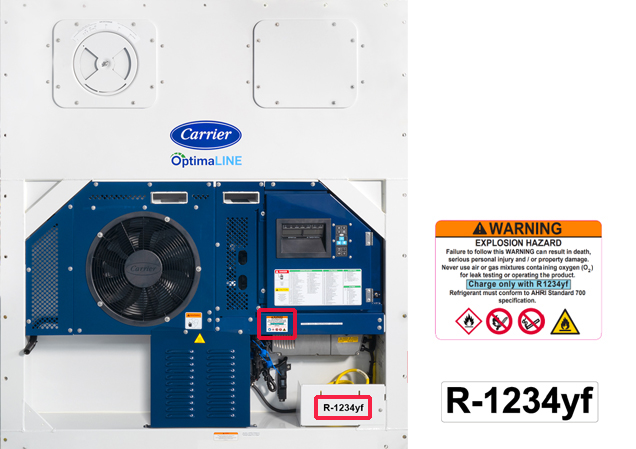
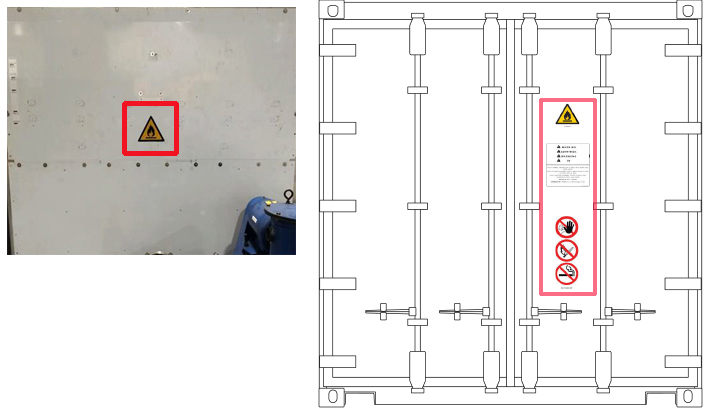
Units charged or converted to R1234yf refrigerant will have safety labels installed. Refer to Figure 1.1 below for reference.
Figure 1.1 Safety Labels R1234yf
1.7Specific Hazard Statements in this Manual
To help identify the label hazards on the unit and explain the level of awareness each one carries, an explanation is given with the appropriate consequences:
DANGER - an immediate hazard that WILL result in severe personal injury or death.
WARNING - a hazards or unsafe condition that COULD result in severe personal injury or death.
CAUTION - a potential hazard or unsafe practice that could result in personal injury, product or property damage.
The statements listed below are applicable to the refrigeration unit and appear elsewhere in this manual. These recommended precautions must be understood and applied during operation and maintenance of the equipment covered herein.
Prior to using R1234YF refrigerant, be sure to have taken the necessary in-country or local A2L refrigerant training for safe handling and transportation of mildly flammable refrigerants while also taking the latest Carrier OEM equipment training for the unit being worked on.
Any maintenance, service or repair on a unit using R1234yf refrigerant should only be carried out by trained and authorized personnel.
EXPLOSION HAZARD: Failure to follow this WARNING can result in death, serious personal injury and / or property damage. Never use air or gas mixtures containing oxygen (O2) for leak testing or operating the product. Charge only with refrigerants R-134a, R-513A or R1234yf as specified for the unit model number: Refrigerant must conform to AHRI Standard 700 specification.
Before performing any “hot work,” including but not limited to brazing or welding on a unit that has been charged with R1234yf, refrigerant must be reclaimed until the equipment gauge indicates 20 in HG (-0.67 Bar) of vacuum. Nitrogen purge is also required.
If Alarm AL084 or AL085 occurs, manually open the fresh air vent and back container doors. Then, wait at least 10 minutes prior to entry or unloading of the container for service. Container may contain low oxygen or flammable atmosphere. Do not enter the container until the alarm is acknowledged and cleared.
If a leak is realized in the Evaporator section on a loaded in route unit, do not continually top off with R1234yf refrigerant to maintain cool as it can collect within the container.
Beware of unannounced starting of the evaporator and condenser fans. The unit may cycle the fans and compressor unexpectedly as control requirements dictate.
Do not attempt to remove power plug(s) before turning OFF the Start-Stop switch (ST), unit circuit breaker(s) and external power source.
Make sure the power plugs are clean and dry before connecting to the power receptacle.
Make sure that the unit circuit breaker(s) (CB-1 & optional CB-2) and the Start-Stop switch (ST) are in the “O” (OFF) position before connecting to any electrical power source.
Make sure the start/stop switch is OFF, unit circuit breaker(s) (CB-1 and optional CB-2) is OFF and the power plug disconnected before servicing unit components or moving parts. Follow local lockout / tagout procedures for working on equipment.
The compressor can run at hot surface temperatures. A compressor shield is in place to prevent contact with the compressor.
Before disassembly of the compressor, be sure to relieve the internal pressure very carefully by slightly loosening the couplings to break the seal.
There are no serviceable parts on a pressure relief valve (PRV). Attempting to repair or alter the PRV is not permitted. If the PRV has released pressure, the entire PRV must be replaced.
Do not use a nitrogen cylinder if it does not have a pressure regulator.
Do not open the condenser fan grille before turning power OFF and disconnecting power plug.
Oakite No. 32 is an acid. Be sure that the acid is slowly added to the water. DO NOT PUT WATER INTO THE ACID - this will cause spattering and excessive heat.
Wear rubber gloves and wash the solution from the skin immediately if accidental contact occurs. Do not allow the solution to splash onto concrete.
Always turn OFF the unit circuit breakers (CB-1 & optional CB-2) and disconnect main power supply before working on moving parts.
Installation requires wiring to the main unit circuit breaker, CB-1. Make sure the power to the unit is off and power plug disconnected before beginning installation.
If Alarm AL084 occurs, manually open the fresh air vent and back container doors. Then, wait at least 10 minutes prior to entry or unloading of the container for service.
When charging the unit with R-513A refrigerant, charge as a liquid only. R-513A is an azeotrope blend containing R1234yf and R-134a. Charging or topping off as a vapor will result in an incorrect mixture of blend in the system.
Only OEM-approved components, including controller software, should be used in case of replacement.
Charge water-cooled condenser or receiver according to nameplate specifications to ensure optimal unit performance.
Do not remove wire harnesses from controller modules unless you are grounded to the unit frame with a static safe wrist strap.
Unplug all controller module wire harness connectors before performing arc welding on any part of the container.
Pre-trip inspection should not be performed with critical temperature cargoes in the container.
When a failure occurs during automatic Pre-Trip testing, the unit will suspend operation awaiting operator intervention.
To prevent trapping liquid refrigerant in the manifold gauge set, make sure set is brought to suction pressure before disconnecting.
The scroll compressor achieves low suction pressure very quickly. Do not use the compressor to evacuate the system below 0 psig. Never operate the compressor with the suction or discharge service valves closed (front seated). Internal damage will result from operating the compressor in a deep vacuum.
A hermetically sealed compressor should not be opened and/or repaired. Doing so can cause a loss in performance and premature system failure due to the precision machinery and assembly required within the compressor. To repair the unit, remove the faulty compressor and replace with an approved Carrier compressor. If the return of the compressor is not required, follow local waste collection & recycling regulations in discarding the compressor.
Electrical Hazard. After disconnecting the power supply, wait seven minutes before servicing the Variable Frequency Drive (VFD) to allow capacitors to completely discharge.
Take necessary steps (place plywood over coil or use sling on motor) to prevent motor from falling into condenser coil.
Do not remove wire harnesses from module unless you are grounded to the unit frame with a static safe wrist strap.
Unplug all module connectors before performing arc welding on any part of the container.
Use care when cutting wire ties to avoid nicking or cutting wires.
Do not allow moisture to enter wire splice area as this may affect sensor resistance.