Section 3
3.1.1Refrigeration Unit - Front Section
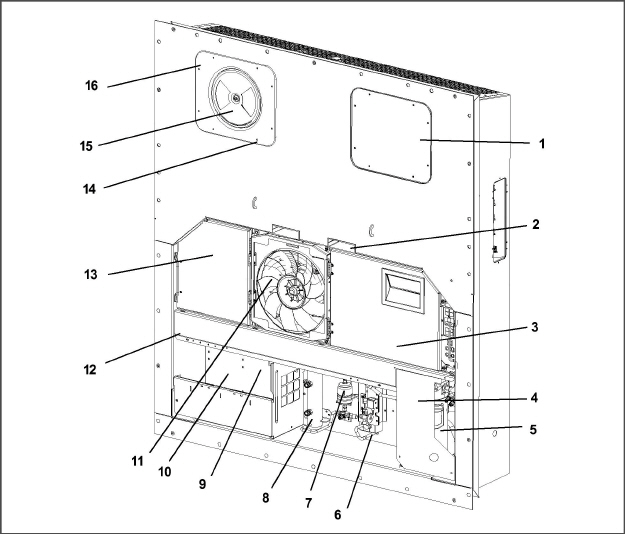
The unit is designed so that the majority of the components are accessible from the front (see Figure 3.1). The unit model number, serial number and parts identification number can be found on the serial plate to the left of the receiver on the back wall of the condenser section.
The function of the upper makeup air vent is to provide ventilation for commodities that require fresh air circulation. A manually operated venting system is located in the upper left access panel.
Figure 3.1 Refrigeration Unit - Front Section
9.Unit Serial Number, Model Number and Parts Identification Number (PID) Plate
10.Power Cables and Plug (Location)
12.Interrogator Connector (Front left)
13.Temperature Recorder (Provisioned)
14.TIR (Transports Internationaux Routiers) Sealing Provisions - Typical All Panels
15.Upper Fresh Air Makeup Vent Panel
16.Access Panel (Evap. Fan #2)
- - - - -
The evaporator section (Figure 3.2) contains the return temperature sensor, humidity sensor, electronic expansion valve, dual speed evaporator fans (EM1 and EM2), evaporator coil and heaters, defrost temperature sensor, heat termination thermostat and evaporator temperature sensors (ETS1 and ETS2).
The evaporator fans circulate air through the container by pulling it in the top of the unit, directing it through the evaporator coil, where it is heated or cooled, and discharging it at the bottom.
Most evaporator components are accessible by removing the upper rear panel (as shown in the illustration) or by removing the evaporator fan access panels (see Figure 3.1, Items 1 and 16).
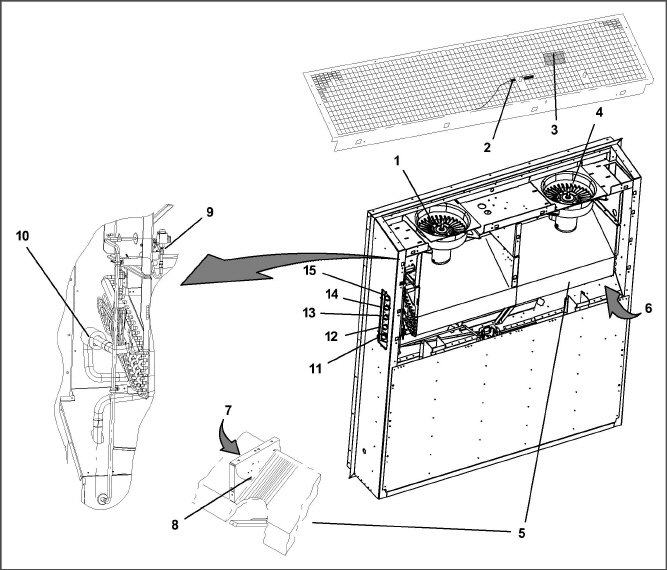
1.Evaporator Fan Motor #1 (EM1)
2.Return Recorder Sensor/Temperature Sensor (RRS/RTS)
4.Evaporator Fan Motor #2 (EM2)
6.Evaporator Coil Heaters (Underside of Coil)
7.Heater Termination Thermostat (HTT)
8.Defrost Temperature Sensor (DTS)
9.Electronic Expansion Valve (EEV)
10.Evaporator Temperature Sensors (Location) (ETS1 and ETS2)
11.Interrogator Connector (Rear) (ICR)
- - - - -
The compressor section (Figure 3.3) includes the compressor, digital unloader valve (DUV), high pressure switch, discharge pressure transducer (DPT), evaporator pressure transducer (EPT) and the suction pressure transducer (SPT).
The supply temperature sensor, supply recorder sensor and ambient sensor are located to the left of the compressor.
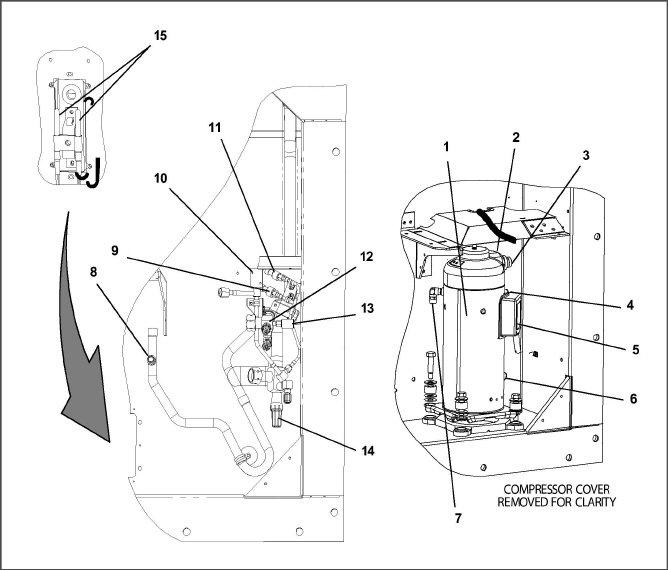
2.Compressor Discharge Temperature Sensor (CPDS) (Location)
4.Suction Connection (Location)
8.Discharge Pressure Transducer (DPT)
9.Suction Pressure Transducer (SPT)
10.Digital Unloader Valve (DUV)
11.Evaporator Pressure Transducer (EPT)
15.Supply Temperature/Supply Recorder Sensor Assembly (STS/SRS)
- - - - -
3.1.5Air-Cooled Condenser Section
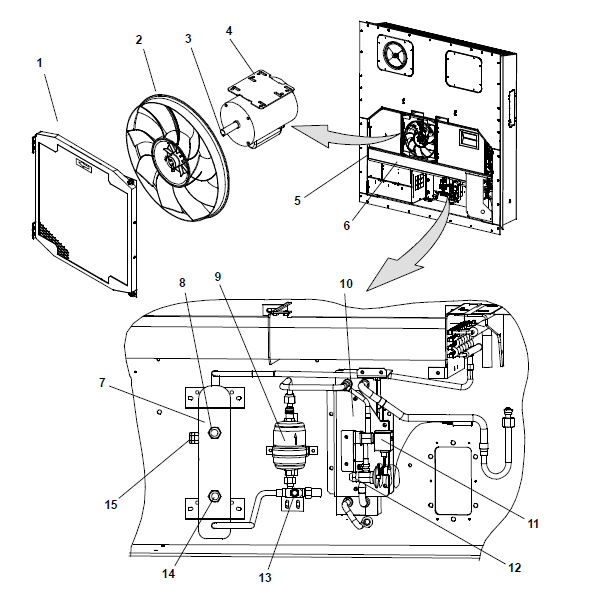
The air-cooled condenser section (Figure 3.4) consists of the condenser fan, condenser coil, receiver, liquid line service valve, filter drier, fusible plug, economizer, economizer expansion valve, economizer solenoid valve (ESV), and sight glass/moisture indicator.
The condenser fan pulls air through the bottom of the coil and discharges it horizontally through the con denser fan grille.
Figure 3.4 Air-Cooled Condenser Section
11.Economizer Solenoid Valve (ESV)
14.Liquid Level/Moisture Indicator
- - - - -
The control box (Figure 3.5) includes: the manual operation switches, circuit breaker (CB-1), compressor, fan and heater contactors, control power transformer, fuses, key pad, display module, current sensor module, controller module and the communications interface module.
3.1.7Communications Interface Module
The optional communications interface module is a slave module that allows communication with a master central monitoring station. The module will respond to communication and return information over the main power line. Refer to the master central monitoring station technical manual for additional information.
Figure 3.5 Control Box Section

2.Compressor Phase A Contactor - PA
3.Compressor Phase B Contactor - PB
6.Communications Interface Module
7.Controller/DataCORDER Module (Controller)
9.Remote Monitoring Receptacle
10.Controller Battery Pack (Standard Location)
11.Interrogator Connector (Box Location)
14.High Speed Evaporator Fan Contactor - EF
15.Low Speed Evaporator Fan Contactor - ES
16.Condenser Fan Contactor - CF
- - - - -
Model Number |
ZMD26KVE-TFD-274 |
|
Weight (With Oil) |
42.9 kg (95 lb) |
|
Approved Oil |
Uniqema Emkarate RL-32-3MAF |
|
Oil Charge |
1774 ml (60 ounces) |
|
Verify at -18°C (0°F) container box temperature |
4.4 to 6.7°C (8 to 12°F) |
|
Verify at -18°C (0°F) container box temperature |
4.4 to 11.1°C (8 to 20°F) |
|
Opens |
54° (+/- 3) C = 130° (+/- 5) F |
|
Closes |
38° (+/- 4) C = 100° (+/- 7) F |
|
Cutout |
25 (+/- 1.0) kg/cm2 = 350 (+/- 10) psig |
|
Cut-In |
18 (+/- 0.7) kg/cm2 = 250 (+/- 10) psig |
|
Charge receiver according to nameplate specifications to ensure optimal unit performance. |
||
Receiver |
4.99 kg (11 lbs) |
|
Melting point |
99°C = (210°F) |
|
Torque |
6.2 to 6.9 mkg (45 to 50 ft-lbs) |
|
Bursts at |
35 +/- 5% kg/cm2 = (500 +/- 5% psig) |
|
Torque |
6.2 to 6.9 mkg (45 to 50 ft-lbs) |
|
Refer to unit model number plate. |
||
CB-1 Trips at |
29 amps |
||
CB-2 (50 amp) Trips at |
62.5 amps |
||
CB-2 (70 amp) Trips at |
87.5 amps |
||
Full Load Amps (FLA) |
13 amps @ 460 VAC |
||
|
380 VAC, Single Phase, 50 Hz |
460 VAC, Single Phase, 60 Hz |
|
Full Load Amps |
1.3 amps |
1.6 amps |
|
Horsepower |
0.43 hp |
0.75 hp |
|
Rotations Per Minute |
1425 rpm |
1725 rpm |
|
Voltage and Frequency |
360 - 460 VAC +/- 2.5 Hz |
400 - 500 VAC +/- 2.5 Hz |
|
Bearing Lubrication |
Factory lubricated, additional grease not required. |
||
Rotation |
Counter-clockwise when viewed from shaft end. |
||
Number of Heaters |
4 |
||
Rating |
750 watts +/- 5% @ 230 VAC |
||
Resistance (cold) |
72 ohms +/- 5% |
||
Type |
Sheath |
||
Number of Heaters |
1 |
||
Rating |
750 watts +/- 7.5% @ 460 VAC |
||
Resistance (cold) |
282 ohms +/-7.5% |
||
Type |
Sheath |
||
Number of Heaters |
1 |
||
Rating |
450 watts +5/-7.5% @ 460 VAC |
||
Resistance (cold) |
470 ohms +/-7.5% |
||
Type |
Sheath |
||
|
380 VAC/3 PH/50 Hz |
460 VAC/3 PH/60 Hz |
|
Full Load Amps High Speed |
1.0 |
1.2 |
|
Full Load Amps Low Speed |
0.6 |
0.6 |
|
Nominal Horsepower High Speed |
0.49 |
0.84 |
|
Nominal Horsepower Low Speed |
0.06 |
0.11 |
|
Rotations Per Minute High Speed |
2850 rpm |
3450 rpm |
|
Rotations Per Minute Low Speed |
1425 rpm |
1725 rpm |
|
Voltage and Frequency |
360 - 460 VAC +/- 1.25 Hz |
400 - 500 VAC +/- 1.5 Hz |
|
Bearing Lubrication |
Factory lubricated, additional grease not required |
||
Control Circuit |
7.5 amps (F3A,F3B) |
||
Controller/ DataCORDER |
5 amps (F1 & F2) |
||
Emergency Bypass |
10 amps (FEB) |
||
Electrical Output |
0.5 VDC to 4.5 VDC over 90 degree range |
||
Supply Voltage |
5 VDC +/- 10% |
||
Supply Current |
5 mA (typical) |
||
Nominal Resistance @ 77°F (25°C) |
7.7 ohms +/- 5% |
||
Maximum Current Draw |
0.7 amps |
||
Nominal Resistance @ 77°F (25°C) |
14.8 ohms +/- 5% |
||
Maximum Current Draw |
929 mA |
||
Coil Feed to Ground (Gray Wire) |
47 ohms |
||
Coil Feed to Coil Feed |
95 ohms |
||
Orange wire |
Power |
||
Red wire |
Output |
||
Brown wire |
Ground |
||
Input voltage |
5 VDC |
||
Output voltage |
0 to 3.3 VDC |
||
Output voltage readings verses relative humidity (RH) percentage: |
|||
30% |
0.99 V |
||
50% |
1.65 V |
||
70% |
2.31 V |
||
90% |
2.97 V |
||
Controller |
Setpoint Range |
-35 to +30°C (-31 to +86°F) |
|
3.4Safety and Protective Devices
Unit components are protected from damage by safety and protective devices listed in Table 3–1. These de vices monitor the unit operating conditions and open a set of electrical contacts when an unsafe condition occurs.
Open safety switch contacts on either or both of devices IP-CP or HPS will shut down the compressor.
Open safety switch contacts on device IP-CM will shut down the condenser fan motor.
The entire refrigeration unit will shut down if one of the following safety devices open: (a) circuit breaker(s); (b) fuse (F3A/F3B, 7.5A); or (c) evaporator fan motor internal protector(s) - (IP).
Starting at the compressor, (see Figure 3.6) the suction gas is compressed to a higher pressure and temperature.
The refrigerant gas flows through the discharge line and continues into the air-cooled condenser. When operating with the air-cooled condenser active, air flowing across the coil fins and tubes cools the gas to saturation temperature. By removing latent heat, the gas condenses to a high pressure/high temperature liquid and flows to the receiver, which stores the additional charge necessary for low temperature operation.
The liquid refrigerant continues through the liquid line, the filter drier (which keeps refrigerant clean and dry) and the economizer (not active during standard operation) to the electronic expansion valve. As the liquid refrigerant passes through the variable orifice of the expansion valve, some of it vaporizes into a gas (flash gas). Heat is absorbed from the return air by the balance of the liquid, causing it to vaporize in the evaporator coil. The vapor then flows through the suction tube back to the compressor.
During the standard mode of operation, the normally closed digital unloader valve (DUV) controls the system refrigerant flow and capacity by loading and unloading the compressor in frequent discrete time intervals. If the system capacity has been decreased to the lowest allowable capacity with the DUV, the unit will enter a trim heat mode of operation, during which the controller will pulse the evaporator heaters in sequence with the compressor digital signal in order to absorb the excess capacity.
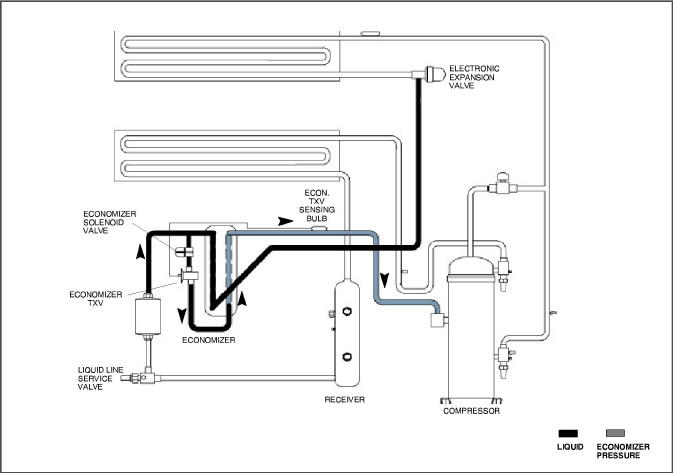
In the economized mode, (see Figure 3.7) the frozen and pull down capacity of the unit is increased by sub cooling the liquid refrigerant entering the electronic expansion valve. Overall efficiency is increased because the gas leaving the economizer enters the compressor at a higher pressure, therefore requiring less energy to compress it to the required condensing conditions.
Liquid refrigerant for use in the economizer circuit is taken from the main liquid line as it leaves the filter drier. The flow is activated when the controller energizes the economizer solenoid valve (ESV).
The liquid refrigerant flows through the ESV to the expansion valve internal passages, absorbing heat from the liquid refrigerant flowing to the electronic expansion valve. The resultant “medium” temperature/pressure gas enters the compressor at the economizer port fit ting.
When the air temperature falls to 2.0°C (3.6°F) above set point, the DUV unloads the compressor's scroll and begins to reduce the capacity of the unit. Percentage of the unit capacity is accessed through code select 01 (Cd01). For example, if Cd01 displays 70, it indicates that the compressor is operating unloaded with the DUV engaged 30% of the time.
3.5.3Electronic Expansion Valve
The microprocessor controls the superheat leaving the evaporator via the electronic expansion valve (EEV), based on inputs from the evaporator pressure transducer (EPT). The microprocessor transmits electronic pulses to the EEV stepper motor, which opens or closes the valve orifice to maintain the superheat set point.
Figure 3.6 Refrigeration Circuit Schematic - Standard Operation
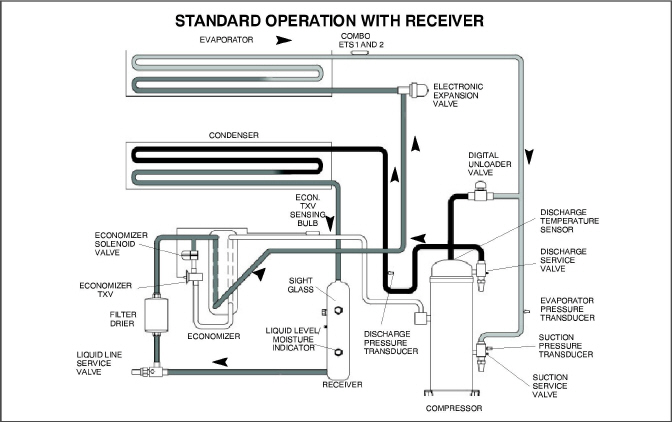
Figure 3.7 Refrigeration Circuit Schematic - Economized Operation